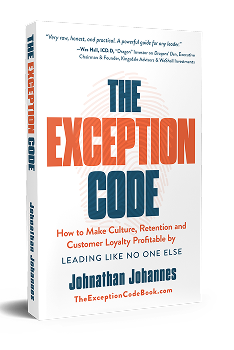

What if the most powerful leadership development journey wasn’t found in a classroom, a seminar, or an executive training program, but in writing a book?
For decades, we’ve been told that the path to leadership mastery lies in accumulating degrees, certifications, and attending high-powered workshops. And while these certainly provide value, they have a fundamental limitation:
The learning stops the moment you leave the classroom.
Writing a book forces you into continuous learning. It’s an intellectual workout that never ends because it demands:
- Challenging your own thinking
- Testing your ideas against reality
- Seeking out new insights from leaders who have walked the path before you
- Breaking down complex leadership concepts into practical, actionable lessons
This is the exceptional approach I’ve chosen to take, one that aligns with #TheExceptionCode. Instead of pursuing another degree, I’m committing to a learning process that will push me beyond my comfort zone, sharpen my thinking, and provide real value to other leaders.
But I’m not on this journey alone. I want to learn from you.
How Writing a Book Expands Leadership Mastery Beyond Traditional Learning
Most leaders invest in growth by:
- Pursuing another degree
- Earning another certification
- Attending executive seminars
But these learning models are passive.
They give you information, but they don’t force you to test, refine, and articulate your own.
Here’s the contrarian truth: “The highest level of learning isn’t found in consuming knowledge… it’s found in creating it.”
Writing a book is not just an intellectual challenge, it’s a leadership development accelerator.
Unlike courses, where knowledge is consumed, a book requires deep, structured thinking to build something tangible and valuable for others.
The Hidden Curriculum of Writing a Leadership Book
Every leader talks about continuous learning, but few experience it at this depth. Writing a book forces you to:
Confront Your Own Leadership Philosophy
- Degrees give you frameworks; writing forces you to define your own.
- Workshops teach best practices; writing makes you question if they really work.
- Seminars expose you to ideas; writing forces you to defend and refine your own.
Example: When I led 1st National Bank St. Lucia, I transformed it from a struggling institution into the 3rd fastest-growing bank in the Caribbean, winning @hThe Banker Magazine Bank of the Year for three consecutive years.
But could I break that success into clear, repeatable leadership principles? Could I explain how to do it again? Writing this book is making me sharpen, refine, and deeply analyze what worked, what didn’t, and what leaders can take away from my journey.
This is something a degree or workshop could never force me to do at this level of depth.
Push Beyond Surface-Level Thinking
It’s one thing to say “psychological safety matters.” It’s another to explain how to build it.
It’s easy to talk about “leading with purpose.” It’s harder to define what that looks like daily.
It’s common to emphasize “innovation.” But how do leaders actually foster it in risk-averse cultures?
Example: While writing about “Culture of Legacy,” I realized that leadership isn’t just about succession planning or high performance, it’s about embedding impact so deeply that an organization thrives long after you’ve left.
This insight didn’t come from a conference. It came from distilling my own experiences into something that others can apply.
Learn in Real-Time from Other Leaders
Writing a book isn’t about sitting alone with your thoughts, it’s about engaging with the best minds in leadership today. This is where writing a book outshines traditional learning models, it forces you to learn from peers, mentors, and innovators while actively building something meaningful.
That’s why I’m inviting you to be part of this journey.
If you’re a leader, business owner, or founder who has transformed an organization, challenged the status quo, or built something lasting, I want to hear from you.
Your insights could help shape this book, and together, we can build something that will inspire the next generation of leaders.
Drop a comment below or send me a DM if you’d be open to a short interview!
Lessons from Leaders Who Wrote Their Way to Mastery
Some of the world’s greatest leaders didn’t just learn leadership, they documented their growth through writing.
Phil Knight (Nike Founder) wrote Shoe Dog, which wasn’t just a memoir, it was an exercise in unpacking decades of decision-making and risk-taking.
Ben Horowitz (Venture Capitalist) wrote The Hard Thing About Hard Things, which forced him to confront and structure lessons on failure, resilience, and leadership under extreme pressure.
Angela Duckworth (Grit Researcher) wrote Grit, which wasn’t just research, it was her journey to understanding how perseverance drives success.
These leaders didn’t just write books, they used the process to refine their thinking, extract leadership lessons, and create something of lasting value.
A Roadmap for Leaders Who Want to Write Their Own Book
If writing a book is the ultimate leadership development challenge, how do you start?
Here’s a 3-step roadmap:
- Define Your Core Leadership Insight – What do you uniquely know about leadership that others need to learn?
- Seek Conversations with Other Leaders – Don’t write in isolation, engage with those who challenge and sharpen your ideas.
- Turn Experience into Lessons – Your past leadership successes and failures are a goldmine of knowledge, turn them into frameworks others can apply.
This is exactly what I’m doing with this project and I’d love for you to be part of it.
Join Me in This Conversation
What’s the most unconventional leadership development path you’ve taken? Drop a comment, I’d love to exchange insights.
Are you a leader who has challenged the norm, built something impactful, or led through transformation? I’d love to interview you. Drop me a message and let’s connect!
Follow me & #TheExceptionCode for bold, high-impact leadership insights.
#Leadership #Growth #Innovation #BeExceptional #CultureOfLegacy #LeadershipDevelopment
#TheExceptionCode