
“If your team can’t move without you, you’re not leading, you’re limiting.”
That realization didn’t come from a book.
It came from watching opportunity after opportunity stall at my desk because I hadn’t yet learned how to decide how decisions should be made.
That’s why when I saw the MIT Sloan decision matrix, it stopped me cold.
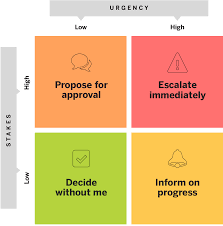
In just four boxes, it captures what many leaders never pause to map:
- Not all decisions need you.
- Not all escalations are wise.
- Sometimes silence is a signal.
- And clarity is a leadership gift.
The Four Decision Zones – A Leadership Mirror
This framework breaks decision-making into two axes: urgency and stakes. Each quadrant offers guidance, but it also reveals where your instincts might be getting in the way.
1. Escalate Immediately (High Stakes, High Urgency)
Yes, you need to be involved here.
But if every decision lives here, you haven’t built trust, you’ve built dependence.
2. Propose for Approval (High Stakes, Low Urgency)
This is where clarity and coaching matter most.
Teach your team what a “complete” proposal looks like so you’re not micromanaging, just fine-tuning.
3. Inform on Progress (Low Stakes, High Urgency)
Speed matters. But so does rhythm.
Set the expectation: keep me posted, but don’t wait for me.
4. Decide Without Me (Low Stakes, Low Urgency)
This is the leadership sweet spot.
If this box stays empty on your team’s radar, you’re likely burning out while others hold back.
A Real-World Turning Point
During my time as Director of Sales at Unicomer, I realized that talented managers were hesitating, not because they lacked competence, but because they didn’t know where the boundaries were.
Every question came upward.
Every decision sat waiting.
And performance stalled, not from lack of skill, but lack of clarity.
So we restructured decision lanes.
We used a version of this framework.
And I told my team:
“If it’s low risk and you’re confident, don’t ask me. Show me.”
The result?
- Better decisions at the frontline
- Fewer bottlenecks
- And most importantly, a culture of earned autonomy
When Delay Became Costly
Years ago, while serving as Managing Director in the banking sector, we had a promising partnership proposal on the table, something that could’ve given us first-mover advantage in digital onboarding.
But because the decision didn’t have a clear escalation path, it bounced between departments, legal reviews, and cautious executives for weeks. Everyone was “waiting on someone else.”
By the time we gave the green light, our competitor had already launched.
We didn’t just lose an opportunity.
We lost momentum, and in banking, momentum is currency.
That was a defining moment for me. I realized the cost of indecision isn’t always visible on a balance sheet, but it always shows up, in lost time, lost trust, or lost talent.
From Control to Courage – The Exception Code Shift
In #TheExceptionCode, I write:
“Empowered teams don’t just move faster.
They move freer, because they’re trusted to.”
And that’s the shift great leaders make.
They stop obsessing over control and start designing clarity.
This matrix isn’t just a guide, it’s a litmus test:
- Where do you default?
- Where do you delay?
- Where can you disappear?
Because real leadership isn’t about being in every room.
It’s about building rooms where the right decisions happen, without you.
Your Turn
- What’s one quadrant you need to let go of more often?
- What would change if your team had clearer permission to move?
Drop your quadrant.
Repost if your team deserves decision clarity.
Follow #TheExceptionCode and @Johnathan Johannes for daily tools, insights, and thought leadership to build bold, agile cultures.
Let’s stop taxing our teams with indecision.
And start leading by letting go, strategically.
#DecisionMaking #AgileLeadership #EmpoweredTeams
#TheExceptionCode